Sphynx cat history: from a Toronto kitten to the hairless show cat
Sphynx cat history from the 1966 Toronto kitten Prune to the Canadian and Minnesota hairless cats, CFA recognition in 2002 and photographing one for a portrait.
By Purrealism
The Sphynx cat is one of the newest pedigree breeds in the Cat Fanciers's Association register and one of the most recognised cats in the world. The breed has no visible coat, giving it an outline that reminds many people of the sphinx statue at Giza, and the name was borrowed from that statue by the Canadian breeders who first worked with the type. This guide follows the Sphynx from the kitten born in Toronto in 1966, through the Minnesota and Canadian lines that saved the breed, to its recognition by the CFA in 2002, and ends with how to photograph one for a royal portrait.
Prune and the first Toronto kitten
The modern Sphynx breed begins with a single kitten born in Toronto, Ontario, in 1966. The Cat Fanciers's Association says the kitten, a male called Prune, was born hairless to a domestic shorthair mother called Elizabeth, as part of an otherwise normal litter. The hairless coat was a natural genetic mutation, and the owners decided to try to establish a breed from the kitten.
The first breeding attempt was limited by the small number of related cats. Prune was bred to his mother Elizabeth and to half-sisters from later litters. A small number of hairless kittens resulted, and the line was shown as the Canadian Hairless at local cat shows during the late nineteen sixties and early nineteen seventies. But the breeding was too closely related. Within a few generations the health of the line had declined and most of the kittens died or were sterile.
By the mid nineteen seventies, the Prune line was effectively over. The CFA says the breed as we know it today does not descend from Prune, although the name Sphynx and the initial recognition of the hairless type in Canada come from that first attempt.
Minnesota farm cats and the second start
In 1975 and 1976, two hairless kittens were born on a Minnesota farm to a cat called Jezabelle. The Cat Fanciers's Association says Milt and Ethelyn Pearson, the farm owners, found the two kittens in Jezabelle's litters and recognised them as unusual. The kittens were named Epidermis and Dermis. The Pearsons sold them to an Oregon breeder named Kim Mueske, who began a new breeding programme.
At almost the same time, three more hairless kittens were found in Toronto in 1978. The CFA says the Toronto kittens, called Bambi, Punkie and Paloma, were rescued from the street. Two of them were sent to a Dutch breeder named Hugo Hernandez. The Minnesota and Toronto cats carried a different recessive hairless gene from the Prune line, and the two groups were bred together to produce a wider gene pool for the new breed.
The combination of the two lines, sometimes crossed with Devon Rex cats to broaden the pool further, produced the Sphynx that is shown in cat registries today. The breed's shape, its ear size, its eye shape and its skin colour all trace back to the Minnesota and Toronto foundation cats of the nineteen seventies, not to Prune.
A name borrowed from Giza
The Sphynx takes its name from the stone sphinx at Giza in Egypt, not from the mythical Greek sphinx. The Cat Fanciers's Association says the first Canadian breeders thought the bare, angular outline of a hairless cat looked like the Egyptian statue, and the name has been attached to the breed since the Prune line of the late nineteen sixties.
The reference does not mean the breed is Egyptian. There is no evidence of a hairless breed in Egypt, and the ancient cats shown in Egyptian art were ordinary shorthaired cats, not hairless ones. The name is a visual comparison only. Several other hairless breeds and crossbreeds use similar names, including the Peterbald and the Donskoy, which developed independently in Russia with their own hairless gene.
The hairless gene and the fine down
A Sphynx is not completely bare. The Cat Fanciers's Association says the skin is covered by a fine down, often compared to the texture of peach fuzz or warm suede. The breed can have short, soft hairs on the ears, the muzzle, the tail and the back of the feet. Whiskers and eyebrows may be present, partly broken or missing entirely.
The hairless coat comes from a recessive gene. A kitten needs two copies of the gene, one from each parent, to be hairless. The CFA says the Sphynx gene is different from the gene in the earlier Prune line and from the gene in the Russian hairless breeds, which is why the three hairless breeds cannot be crossed to produce reliable hairless offspring. Each hairless breed carries its own version of the mutation.
The lack of a normal coat makes the cat's skin visible, and the skin carries the colour patterns a coat would normally show. A Sphynx can be solid black, white, tortoiseshell, tabby or point-patterned, and all of these colours are recognised by the CFA. A tabby Sphynx has visible tabby stripes in the skin pigment, even though the coat itself is only fine down.
CFA recognition
The Cat Fanciers's Association accepted the Sphynx for registration in 1998 and granted the breed full championship status in 2002. The International Cat Association had accepted the breed earlier, in 1986, so the Sphynx had been competing at TICA shows for over a decade before CFA recognition.
Recognition took time for two reasons. The first Prune line had died out, and the CFA wanted to see several generations of healthy cats from the Minnesota and Toronto foundation stock. The second reason was the small gene pool. The breed had been built from a handful of foundation animals, and outcrosses to Devon Rex and American Shorthair cats were used to broaden the pool and avoid inbreeding problems. By the late nineteen nineties, the breed had reached the number of healthy animals needed to meet the CFA's requirements.
Care and skin
A Sphynx needs more skin care than a normal cat. The Cat Fanciers's Association says the breed should be bathed on a regular schedule because the oil a cat's skin produces is normally absorbed by the coat. On a Sphynx, with no coat to absorb it, the oil builds up on the skin and in the folds around the eyes, ears and feet. A weekly or fortnightly bath with a mild shampoo is the usual advice.
The ears also need regular cleaning. Without the hair that normally lines a cat's ear canal, wax and debris build up quickly, and the large ears of a Sphynx collect more debris than a smaller-eared breed. The nail beds collect a similar waxy build-up and benefit from weekly wiping.
The breed also needs more warmth than a coated cat. A Sphynx loses body heat through the skin and will seek warm spots in the house: a sunny window, a warm lap, a heated bed. Many Sphynx owners keep soft throws in several rooms so the cat can wrap up when it wants to rest.
The temperament of a Sphynx
The Cat Fanciers's Association describes the Sphynx as friendly, affectionate and highly social. The breed is often called dog-like because it follows people around the house, greets guests at the door and seeks warm contact with its owners. Sphynx cats are active and curious, and they usually get on well with other cats, dogs and children.
The sociability of the breed is sometimes attributed to the need for warmth. A Sphynx without warm clothing or a warm companion loses body heat quickly, and seeking contact with a warm human is a practical choice as much as a sign of affection. Whatever the cause, the Sphynx is one of the most people-oriented breeds in the CFA register, and the breed's reputation for bonding strongly with its owner is well established.
Photographing a Sphynx cat for a royal portrait
A Sphynx cat's best features for a portrait are the wrinkled skin, the large ears and the large eyes. The steps below add to the full guide on photographing cats:
- Sit at the cat's eye level. The large ears and the wrinkles around the face show at their best when the camera is level with the cat. A camera held above looks down on the head and loses the ear shape.
- Use soft window light from the side. Side light brings out the texture of the skin and the wrinkles. Front light flattens the face and loses the detail of the folds.
- Give the cat a warm surface. A Sphynx loses heat quickly and will not settle on a cold floor. A soft throw, a warm cushion or a folded blanket keeps the cat still and relaxed long enough for the shot.
- Catch the ears forward. The large ears are part of the breed's signature, and a relaxed, upright ear position gives the portrait more character than ears flattened back.
- Choose a plain background. The skin is already detailed, with colour patterns, wrinkles and the fine down. A plain background keeps the focus on the face.
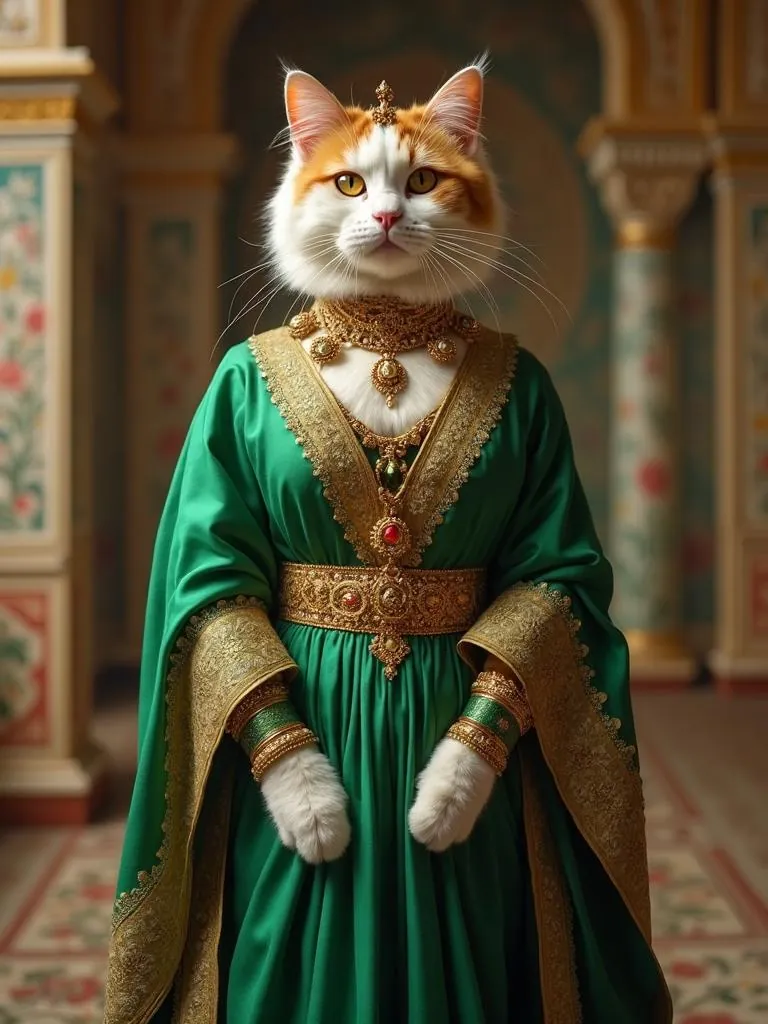
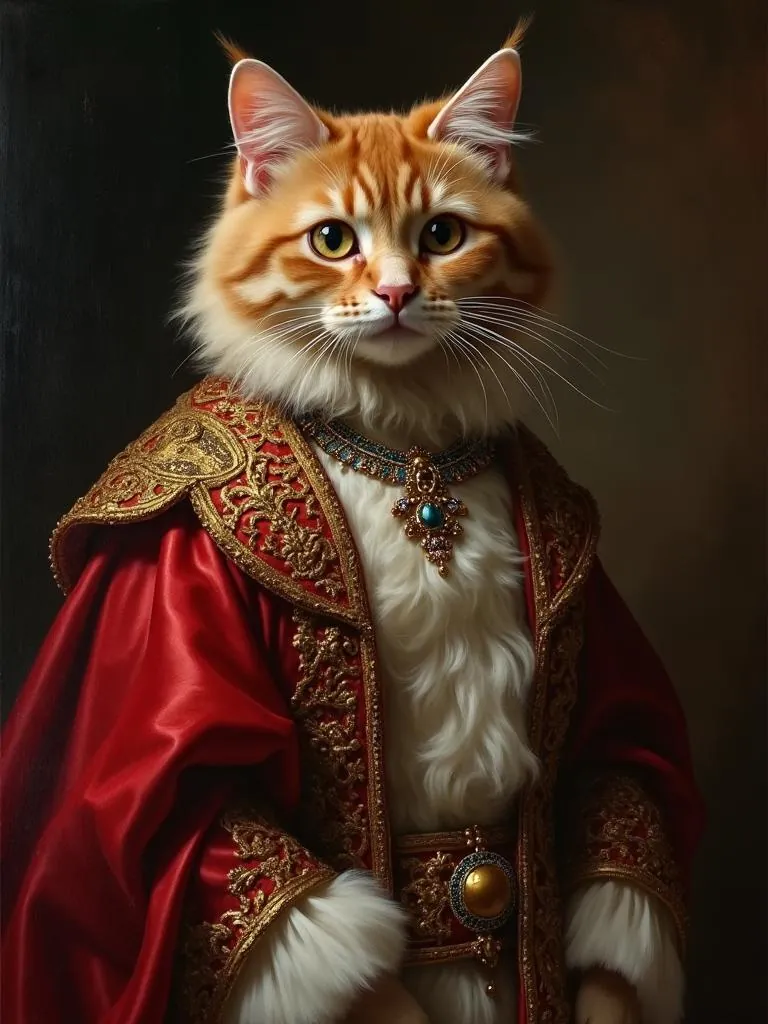
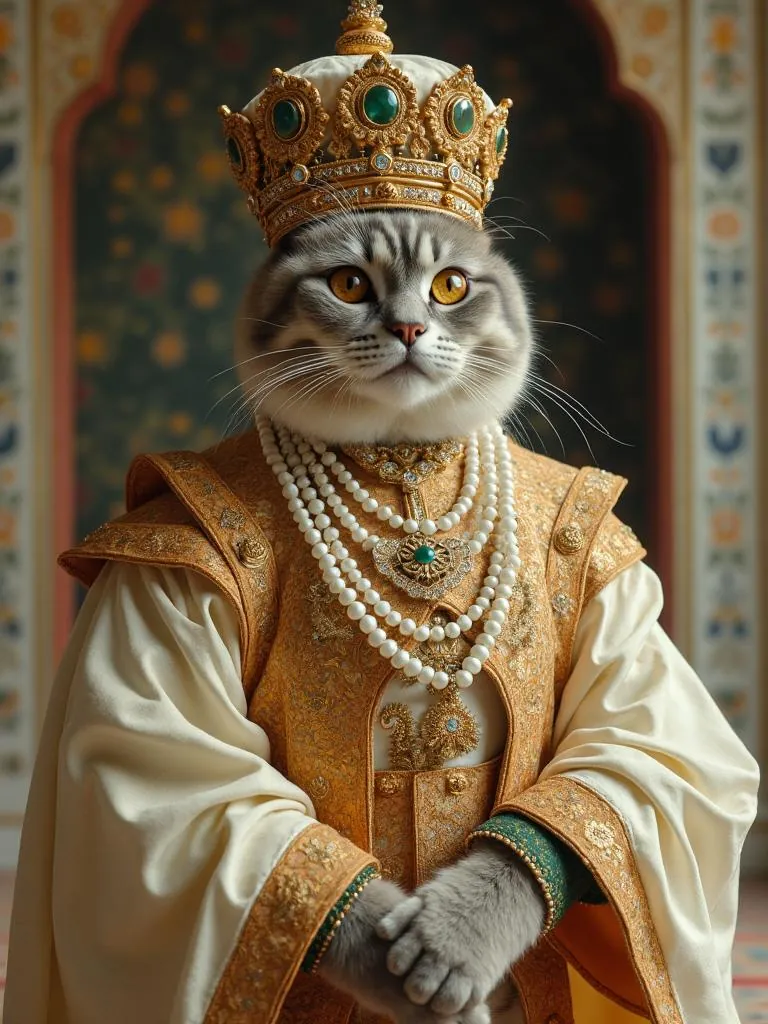
The gallery has portraits of cats in Mughal, Maharani and Renaissance styles. When your photo is ready, the portrait studio lets you choose from fifteen royal styles and upload a photo of up to five MB.
Questions and answers
Where did Sphynx cats come from?
Sphynx cats come from Canada and the United States, where the modern breed was built from a handful of hairless kittens born to ordinary domestic shorthair cats. The Cat Fanciers's Association says the first known hairless kitten of the modern breed was born in Toronto in 1966. A second group of hairless cats was found in Minnesota in 1975 and 1976, and a third group in Toronto in 1978. The three groups form the base of the modern breed.
Who was Prune?
Prune was the first hairless kitten of the modern Sphynx breed. The Cat Fanciers's Association says Prune was born in 1966 in Toronto, Ontario, to a domestic shorthair cat called Elizabeth. The kitten was a natural genetic mutation, born hairless in an otherwise normal litter. Prune was bred to his mother and to half-sisters in the first attempt to establish the breed, but the line died out within a few generations because of health problems.
Who were Epidermis and Dermis?
Epidermis and Dermis were two hairless kittens born in Minnesota in 1975 and 1976, to a farm cat called Jezabelle owned by Milt and Ethelyn Pearson. The Cat Fanciers's Association says the Pearsons sold the two kittens to a breeder in Oregon, who used them with a group of hairless cats found in Toronto in 1978 to rebuild the breed. The Minnesota and Toronto cats are the two main foundation groups of the modern Sphynx.
Why do Sphynx cats have no hair?
Sphynx cats have no visible coat because of a recessive gene that produces hair loss. The Cat Fanciers's Association says the hairless gene found in the modern Sphynx is different from the hairless gene in the earlier Canadian hairless lines. The gene produces a thin layer of fine down over the body, so a Sphynx is not completely bare but has a suede-like texture. The gene is recessive, so two copies are needed to produce a hairless cat.
When was the Sphynx recognised as a breed?
The Cat Fanciers's Association accepted the Sphynx for registration in 1998 and granted the breed full championship status in 2002. The International Cat Association had accepted the breed earlier, in 1986. Recognition took time because the first line from Prune had died out, and CFA breeders had to show that the second and third foundation groups produced healthy cats over several generations. Today the Sphynx is one of the few hairless breeds recognised by the major cat registries.
Where does the name Sphynx come from?
The breed is named after the sphinx statue of ancient Egypt. The Cat Fanciers's Association says breeders chose the name because the first hairless cats had a bare, angular look that reminded them of the stone sphinx at Giza. The reference is to the Egyptian statue, not to the mythical Greek creature of the same name. The name was in use for the breed long before CFA recognition, dating back to the first Toronto breeding attempts in the late nineteen sixties.
Are Sphynx cats really completely hairless?
Sphynx cats are not completely bare. The Cat Fanciers's Association says the skin is covered by a fine down, often compared to the texture of peach fuzz or warm suede. The breed can have short, soft hairs on the ears, muzzle, tail and the back of the feet. Whiskers and eyebrows may be present, broken or missing entirely. The lack of a normal coat makes the skin visible, and most Sphynx cats carry colour patterns in their skin pigmentation.
Do Sphynx cats need baths?
Sphynx cats do need regular baths because they have no coat to absorb the oils their skin produces. The Cat Fanciers's Association says a Sphynx should be bathed on a regular schedule to remove skin oils, and the ears and nail beds need cleaning because wax and debris build up without the normal coat to filter them. Most Sphynx cats accept bathing from kittenhood, and the skin dries quickly with a soft towel.
What is the temperament of a Sphynx cat?
The Cat Fanciers's Association describes the Sphynx as friendly, affectionate and highly social. The breed is often called dog-like because it tends to follow people around, greet guests at the door and seek warm contact with its owners. Sphynx cats are active and curious, and they usually get on well with other cats, dogs and children. The breed is notable for the strength of the bond it forms with its household.
How do I photograph a Sphynx cat for a royal portrait?
A Sphynx cat's most striking features are its wrinkled skin, its large ears and its large eyes. Hold the camera at the cat's eye level and use soft window light from the side to bring out the texture of the skin and the wrinkles around the face. A warm throw or a soft rug helps the cat stay still, since Sphynx cats seek warmth. The guide to [photographing cats](/guides/pet-photo-guide/photographing-cats) has more steps on focus.
Sources
- Sphynx, The Cat Fanciers's Association
- Sphynx Breed Profile, The Cat Fanciers's Association
- Sphynx History, The Cat Fanciers's Association
Share this guide
The button copies a ready-written post, then opens LinkedIn. Paste the text into the post box.
Go deeper
The full guides on this topic, each a set of pages with sources: