Russian blue cat history: from the port of Arkhangelsk to the show ring
Russian blue cat history from the port of Arkhangelsk and the Crystal Palace show to the post-war rebuild, the double coat and photographing one for a portrait.
By Purrealism
The Russian blue is one of the oldest natural cat breeds in the Cat Fanciers's Association register and one of the few pedigree cats with a specific geographic origin. The breed takes its name from the city of Arkhangelsk on the White Sea in northern Russia, and its silver-tipped blue coat has been the signature of the breed from the first English shows in the eighteen seventies. This guide follows the Russian blue from the port of Arkhangelsk, through the Crystal Palace show of 1875, to the post-war rebuild of the breed, and ends with how to photograph one for a royal portrait.
The port of Arkhangelsk
The Cat Fanciers's Association lists the Russian blue as a natural breed, meaning it developed in a region rather than through selective breeding in a kennel. The region in question is the far north of Russia. Archangel, or Arkhangelsk in modern transliteration, was the main Russian port on the White Sea, open to European shipping through the summer months when the ice retreated.
The cold climate shaped the cat. The double coat that is the Russian blue's signature is a response to a northern winter, a thick undercoat under a slightly longer guard hair, producing a dense, plush texture that stands up away from the body. The CFA says the texture is similar to seal fur. A finger pressed into the coat leaves a visible mark where the hair has been parted, a feature used by judges to check for the required density.
Local cats of this type were taken aboard ships for the usual reason, to keep rats and mice out of the hold. When the ships called at English ports, the cats went ashore, and by the eighteen sixties the first Russian blues had reached English homes. The CFA says these cats were originally known in English as the Archangel Cat, after the port from which they were believed to come.
The Crystal Palace show
The first known show appearance of the Russian blue was at the Crystal Palace cat show in London in 1875. The Cat Fanciers's Association says the breed competed in a general class open to all blue cats, including the British Blue, which was the English domestic blue shorthair of the period. The two breeds were judged together, and the mixed class did not help the Russian blue to develop as a distinct type.
A separate class for the Russian blue was created at the Crystal Palace show in 1912. This change gave the breed its own show category and let English breeders focus on the type that defined the Russian blue: the double coat, the silver tipping and the vivid green eyes. The CFA says the Crystal Palace separation is the point at which the Russian blue became a recognised breed rather than a regional variety of the blue domestic cat.
By the nineteen twenties and nineteen thirties, the Russian blue was being bred in small numbers in England and Scandinavia. The Swedish and Danish breeders of the period were particularly active, and the Scandinavian lines became the main source of breeding stock for the post-war rebuild.
The post-war rebuild
The Second World War almost ended the Russian blue. The Cat Fanciers's Association says breeding kennels in England and Europe were disrupted, food supplies were limited, and the gene pool for the breed shrank to a small number of surviving cats. By the late nineteen forties, only a handful of pedigreed Russian blues remained in Europe, and most of those were in Scandinavia.
Breeders in England and Scandinavia rebuilt the breed by crossing the surviving Russian blues with Siamese and British Blue cats. The Siamese cross brought back the fine bone structure and the almond-shaped eye, while the British Blue cross reinforced the dense, short coat and the solid blue colour. The CFA says the outcrosses broadened the gene pool but changed the type of some lines for a generation or two, and it took until the nineteen sixties for the modern Russian blue type to be stable in the show ring.
American breeders began working with the breed after the war, importing cats from England and Scandinavia. The CFA accepted the breed for registration and championship status, and by the nineteen eighties the Russian blue was established in the American show ring with its own breed club and standard.
The silver sheen
The Russian blue's coat is what sets the breed apart from every other solid blue cat. The Cat Fanciers's Association standard calls for an even, bright blue coat with a lustrous silver tipping. The silver is a feature of the hair itself, not a colour overlay: each individual hair is a solid blue for most of its length and silver at the tip, and the combination catches light in a way that produces a shimmering, almost metallic appearance.
The dense double coat lifts the silver tipping away from the body. The tipping on a Russian blue is more visible than the equivalent tipping on a shorthaired blue cat with a single coat, because the two layers of the double coat spread the hair tips evenly across the surface. The CFA says the texture is unlike any other breed and is one of the clearest tests of a well-bred Russian blue.
A kitten may show faint ghost tabby markings in the first weeks, and these fade as the coat develops. By the first birthday, the adult coat has come in and the ghost markings have gone. A Russian blue that keeps visible tabby markings into adulthood is not showing the breed standard and is likely to be a cross or a poor quality example.
The green eye
The second signature feature of the breed is eye colour. The Cat Fanciers's Association standard describes the eye as vivid green, wide-set and almond-shaped. The green is a saturated, clear colour, not the yellow-green or amber of many other breeds.
Kittens are born with yellow or amber eyes and the green develops over the first year of life. A pale or yellow-tinged eye in an adult is a show fault, and judges look for a clear, deep green against the silver-blue coat. The eye shape, almond and slightly upturned at the outer corner, adds to the breed's alert expression.
A reserved temperament
The Cat Fanciers's Association describes the Russian blue as quiet, gentle and reserved with strangers but devoted to its own family. The breed is intelligent and sensitive, and it tends to form a strong bond with one or two people in the household. Russian blues are often shy with visitors and may hide when the house is noisy or when strangers arrive.
Within its own household, the Russian blue is affectionate and seeks contact with its owners. The breed has a soft, low voice and rarely vocalises, which is a sharp contrast to the Siamese ancestors used in the post-war rebuild. Many Russian blue owners describe the breed as a shadow, always nearby but not pushy, content to sit on a nearby chair rather than on the lap.
The breed does well in a quiet household and with respectful children. A noisy, high-traffic home may not suit a Russian blue, and the breed may become withdrawn in such an environment. Where the household is calm, the breed is one of the most long-lived cat breeds, with many individuals living into their mid to late teens in good health.
Photographing a Russian blue for a royal portrait
A Russian blue's best features for a portrait are the silver-tipped blue coat, the dense double coat texture and the vivid green eyes. The steps below add to the full guide on photographing cats:
- Use soft window light from the side. Side light catches the silver tipping and shows the texture of the double coat. Front light flattens the coat and loses the shimmer.
- Avoid blue or green backgrounds. A coloured background close to the coat or the eye colour washes out both. A plain cream, white or warm grey wall keeps the focus on the cat.
- Sit at the cat's eye level. The almond eye shape and the silver sheen show at their best when the camera is level with the face. A camera held above the cat flattens the face and loses the eye line.
- Tap the nearest eye to focus. The green eye is the strongest feature after the coat, and a sharp focus on the eye is what carries the portrait.
- Wait for a calm moment. The breed is reserved and often shy with a camera. Let the cat settle in its usual quiet spot and shoot when it is relaxed, not when it is watching the lens.
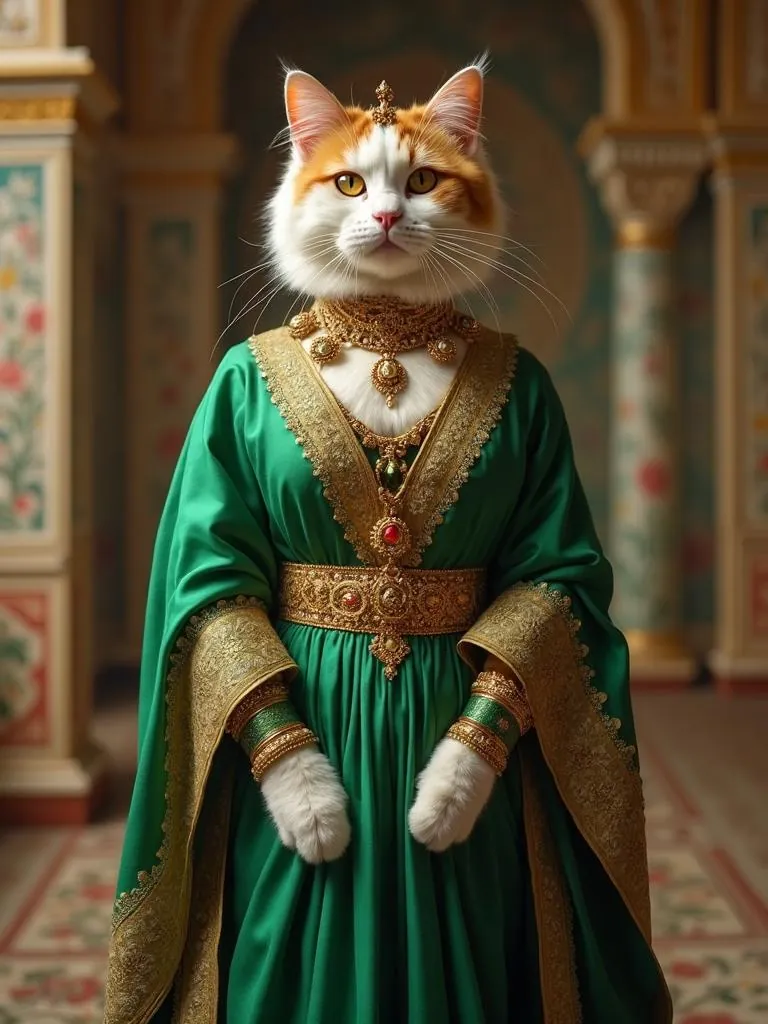
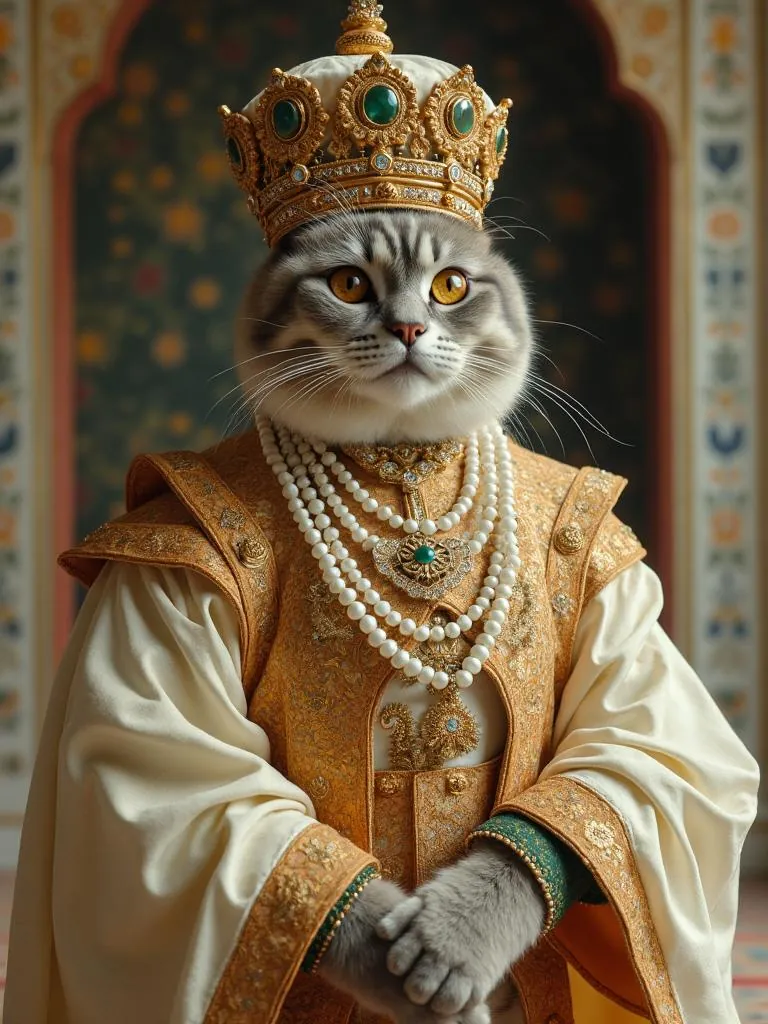
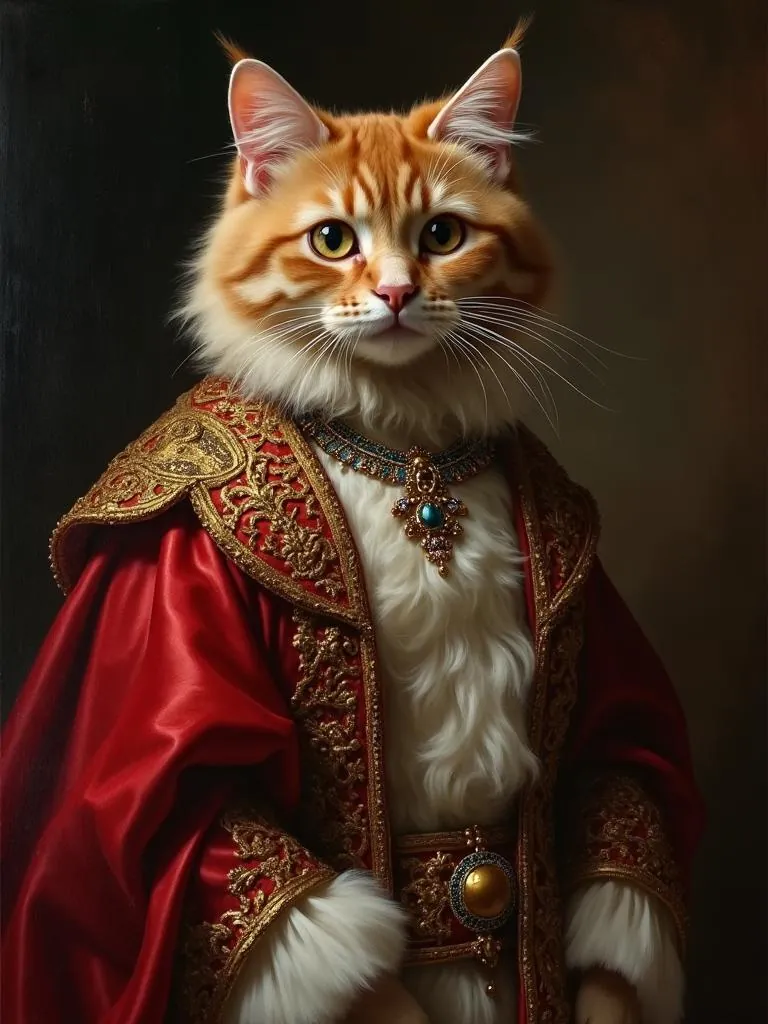
The gallery has portraits of cats in Mughal, Maharani and Renaissance styles. When your photo is ready, the portrait studio lets you choose from fifteen royal styles and upload a photo of up to five MB.
Questions and answers
Where do Russian blue cats come from?
Russian blue cats come from northern Russia, where the breed's ancestors are thought to have lived in the port city of Arkhangelsk on the White Sea. The Cat Fanciers's Association says the breed is one of its natural breeds, meaning it developed in a region rather than being created by selective breeding. Sailors are believed to have brought the cats from Arkhangelsk to northern Europe and Great Britain in the eighteen sixties.
What is the Archangel Cat?
Archangel Cat was the original English name for the Russian blue, named after the Russian port of Arkhangelsk from which the first cats were thought to have come. The Cat Fanciers's Association says the breed was shown under this name at the Crystal Palace in London in 1875. The name was later changed to Russian Blue to reflect the country of origin and the blue colour of the coat, which has been the breed's defining feature from the start.
When was the Russian blue shown in England?
Russian blue cats, then known as the Archangel Cat, were shown at the Crystal Palace cat show in London in 1875. The Cat Fanciers's Association says the breed competed in a class open to all blue cats, including British Blue cats, which made the early classes crowded. A separate class for Russian blue was created at the Crystal Palace show in 1912, giving the breed its own show category and letting breeders focus on type.
What happened to Russian blues after World War Two?
The Russian blue nearly died out during the Second World War because breeding kennels in England and Europe were disrupted and the gene pool shrank to a small number of cats. The Cat Fanciers's Association says breeders in England and Scandinavia rebuilt the breed after the war by crossing surviving Russian blues with Siamese and British Blue cats. The outcrosses broadened the gene pool but changed the type of some lines for a generation or two.
What colour is a Russian blue?
A Russian blue is a solid blue cat with a silver sheen. The Cat Fanciers's Association standard calls for an even, bright blue coat with a lustrous silver tipping that gives the cat a shining appearance. The nose leather is slate grey, the paw pads are lavender pink or mauve and the eyes are vivid green. White markings or patches disqualify a cat from the show ring. A Russian blue kitten may have faint ghost tabby markings that fade by the first birthday.
What makes a Russian blue coat so plush?
The Russian blue has a dense double coat that stands out from the body rather than lying flat. The Cat Fanciers's Association says the coat is short, fine and so dense that a finger pressed into it leaves a visible mark. The texture is described as similar to seal fur. Each hair is tipped with silver, and the combination of the double coat and the silver tipping produces the shimmering effect for which the breed is known.
What colour are a Russian blue's eyes?
Russian blue adults have vivid green eyes. The Cat Fanciers's Association standard describes the eye colour as vivid green, wide-set and almond-shaped. Kittens are born with yellow or amber eyes, and the green colour develops over the first year of life. A pale or yellow-tinged eye in an adult is a show fault. The clear green against the silver-blue coat is one of the breed's most distinctive features.
What is the temperament of a Russian blue?
The Cat Fanciers's Association describes the Russian blue as quiet, gentle and reserved with strangers but devoted to its own family. The breed is intelligent and sensitive and tends to form a strong bond with one or two people in the household. Russian blues are often shy with visitors and may hide when the house is noisy, but they usually seek out their owners and enjoy being near them. The breed has a soft voice and rarely vocalises.
Are Russian blues good family cats?
Russian blues can be good family cats in a calm household. The Cat Fanciers's Association says the breed gets on well with children who are respectful of a cat's space and with other cats and dogs, provided the introduction is gradual. A noisy, high-traffic home may not suit a Russian blue because the breed is sensitive and reserved. In a quiet household the breed forms a close bond with its people and is a long-lived companion.
How do I photograph a Russian blue for a royal portrait?
A Russian blue's best features are its silver-tipped blue coat and vivid green eyes. Use soft window light from the side so the silver tipping catches the light and the double coat shows its texture. Sit at the cat's eye level and tap the nearest eye to focus. A plain background without blue or green tones keeps the focus on the coat and the eyes. The guide to [photographing cats](/guides/pet-photo-guide/photographing-cats) covers angles and timing.
Sources
- Russian Blue, The Cat Fanciers's Association
- Russian Blue Breed Article, The Cat Fanciers's Association
- Russian Blue Breed Standard, The Cat Fanciers's Association
Share this guide
The button copies a ready-written post, then opens LinkedIn. Paste the text into the post box.
Go deeper
The full guides on this topic, each a set of pages with sources: