Scottish fold history: from Susie the barn cat to the folded ear
Scottish fold history from Susie the Perthshire barn cat in 1961 to the folded ear gene, CFA recognition in 1978 and photographing one for a portrait.
By Purrealism
The Scottish fold is a modern cat breed with an unmistakable silhouette: small, round, and distinguished by ears that fold forward and down against the front of the head. The breed began with a single barn cat in rural Scotland in 1961, and the family of a local shepherd kept records that let the breed spread across the Atlantic within a decade. This guide follows the Scottish fold from Susie on a Perthshire farm, through the breeding programme set up by William and Mary Ross, to recognition by the Cat Fanciers's Association, and ends with how to photograph one for a royal portrait.
Susie the Perthshire barn cat
The breed begins with one cat. The Cat Fanciers's Association says a white barn cat called Susie was born in 1961 on a farm in the Perthshire region of Scotland. Her ears folded forward and down against the front of her head, a feature her litter mates and her parents did not share. The farmer who owned the mother kept Susie as a working cat, and at first the folded ears were seen as nothing more than a local curiosity.
In 1963, Susie had a litter of kittens. A local shepherd called William Ross and his wife Mary lived nearby, and they asked the neighbour for one of the kittens. They had already noticed Susie and wanted to see whether the folded ears would appear in the next generation. The neighbour gave them a white female kitten called Snooks, and the breeding programme began from her.
Susie herself did not live long. The CFA says she was killed on the road only three months after the litter, so the entire modern breed descends from Snooks and from a smaller number of related cats taken from the same farm.
The Ross breeding programme
William and Mary Ross built the breed from a small foundation. The Cat Fanciers's Association says they bred Snooks to British Shorthair and British domestic cats, and they kept careful records of the folded and straight-eared kittens in each litter. From the records, it became clear that the folded ear was caused by a single dominant gene: one folded parent crossed with a straight-eared partner produced about half folded kittens and about half straight-eared kittens in each litter.
The Rosses were joined by Pat Turner, a geneticist who kept detailed pedigrees of the first few generations and helped to work out the inheritance pattern of the fold gene. Turner's records are still used as the pedigree base for the Scottish fold today. A small number of cats from the Ross kennel were sent to the United States in the early nineteen seventies, where American breeders took over the main work on the breed.
By the late nineteen sixties, the British Governing Council of the Cat Fancy, the main British cat registry, had registered the Scottish fold under its own name. But that recognition did not last.
The 1971 British withdrawal
The British Governing Council of the Cat Fancy withdrew registration of the Scottish fold in 1971. The Cat Fanciers's Association says the withdrawal followed concerns about the health of the fold gene. Reports from British breeders and veterinarians suggested that some folded cats developed thickening of the tail and joint stiffness in the legs, both signs that the fold gene affected cartilage elsewhere in the body as well as in the ears.
The research that followed showed that the fold gene is a dominant mutation affecting cartilage development throughout the body. A cat with one copy of the gene shows the folded ear but is usually otherwise healthy. A cat with two copies of the gene, from two folded parents, develops a condition called osteochondrodysplasia, which produces short, stiff legs, a thick tail and painful joint changes. Responsible breeders have followed the rule that a folded cat is only ever crossed with a straight-eared partner, so no kitten carries two copies of the gene.
The British registry has not reinstated the Scottish fold. The CFA and The International Cat Association in North America both accept the breed under the one-folded-parent rule, and most Scottish fold breeding today happens in the United States and Canada.
Recognition in North America
The Cat Fanciers's Association accepted the Scottish fold for registration in 1973 and granted it championship status in 1978. The International Cat Association followed in 1979. American breeders imported foundation stock from the Ross kennel and from other British and Belgian breeders during the nineteen seventies, and they developed the breed's two varieties, the Scottish Fold Shorthair and the Scottish Fold Longhair.
The longhair version is sometimes called the Highland Fold. Both varieties carry the fold gene, and both come in a wide range of colours and patterns. The CFA says the breed standard calls for a round head, large round eyes, a short nose and the characteristic forward-folded ears. The body is medium sized, well rounded and padded, with short, well set legs and a medium length tail that tapers to the tip.
The fold gene and the straight sibling
All Scottish fold kittens are born with straight ears. The Cat Fanciers's Association says the fold begins to appear between three and four weeks of age, as the cartilage of the ear develops. In a litter from one folded and one straight-eared parent, about half the kittens develop the fold and about half keep straight ears throughout life.
The kittens with straight ears are not failures. They are called Scottish Straights and are recognised as a separate variety by some registries. A Scottish Straight is important in the breeding programme because it can be bred to another folded cat without producing the two-copy health problem in the offspring. Many American breeders use Scottish Straights as regular partners for folded cats, which doubles the number of healthy folded kittens that can be produced in a year.
The depth of the fold varies. A single fold is the loosest, where the ear bends only at the tip. A double fold bends further down the ear, and a triple fold is the tightest, where the ear lies almost flat against the head. The triple fold is the preferred show look under the CFA standard, but even a single fold is enough for registration.
Colour, pattern and coat
The Cat Fanciers's Association recognises the Scottish fold in almost every colour and pattern. Solid colours include white, blue, black, red and cream. Tabby patterns include silver, brown, red and blue in classic, mackerel and spotted forms. Calico, tortoiseshell, bi-colour and the colour-point pattern are all accepted. The coat may be short or long, and both lengths are judged under the same standard.
The shorthair coat is dense, soft and resilient. The CFA says it stands away from the body and does not lie flat. The longhair coat is soft and fluffy, with a full tail plume and ear tufts. The longhair variety sheds less heavily than many longhaired breeds and is well suited to households with a regular grooming routine.
The Buddha pose and the voice
The Scottish fold is known for its temperament as much as for its ears. The Cat Fanciers's Association describes the breed as gentle, affectionate and even-tempered. The breed has a soft, quiet voice and is not vocal. Scottish folds tend to bond closely with one person in the household but accept other family members and other pets without difficulty.
The breed is also known for sitting in unusual positions. The most famous is the so-called Buddha pose, where the cat sits upright on its haunches with its back legs stretched out in front, often with the front paws resting on the belly. The pose is comfortable for most Scottish folds and is a frequent subject of photos online. Many owners say their folds also sleep flat on their backs, which is less common in other breeds.
The breed is quiet, patient with children and adaptable to apartment life. The Scottish fold does well in multi-pet households, and the CFA says the breed usually accepts a slow introduction to new animals and new people without conflict.
Photographing a Scottish fold for a royal portrait
A Scottish fold's best features for a portrait are the folded ears, the round head and the wide-set eyes. The steps below add to the full guide on photographing cats:
- Sit at the cat's eye level. The folded ears and round face show at their best when the camera is level with the head. A camera held above the cat looks down on the head and loses the ear shape against the skull.
- Use soft window light from the side. Side light brings out the fold of the ear, the roundness of the face and the colour of the coat. Direct light from above flattens the face and hides the ear shape.
- Choose a plain background. The folded ear is the detail that should carry the portrait, and a plain wall or cushion keeps the focus on the head.
- Catch the ear forward. The fold is more visible when the ear tips rest forward against the head. Wait until the cat is relaxed and alert, not startled, so the ears sit in their natural folded position.
- Tap the nearest eye to focus. The wide-set, round eyes are the second feature of the breed after the ears, and a sharp focus on the eye is what carries the shot.
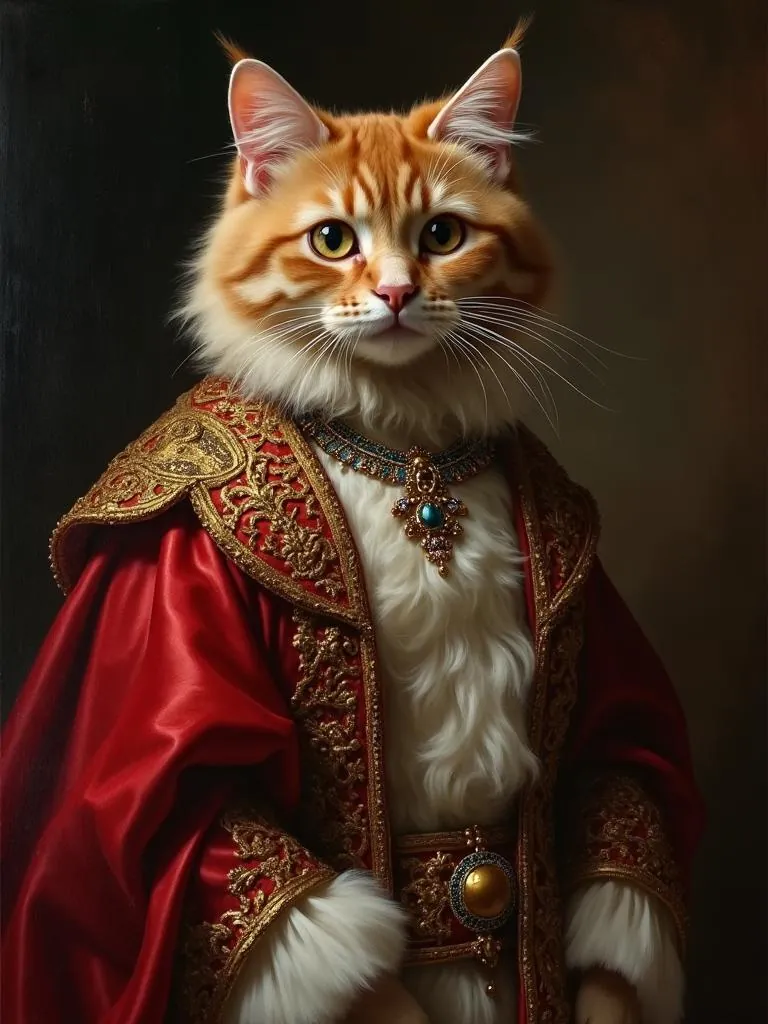
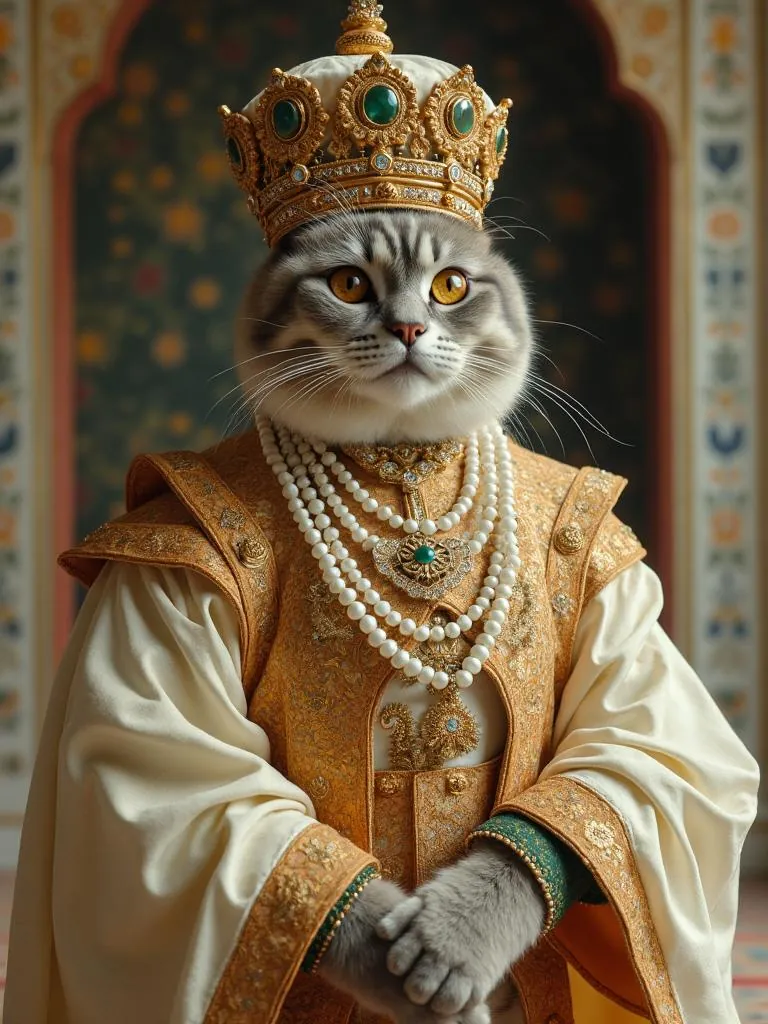
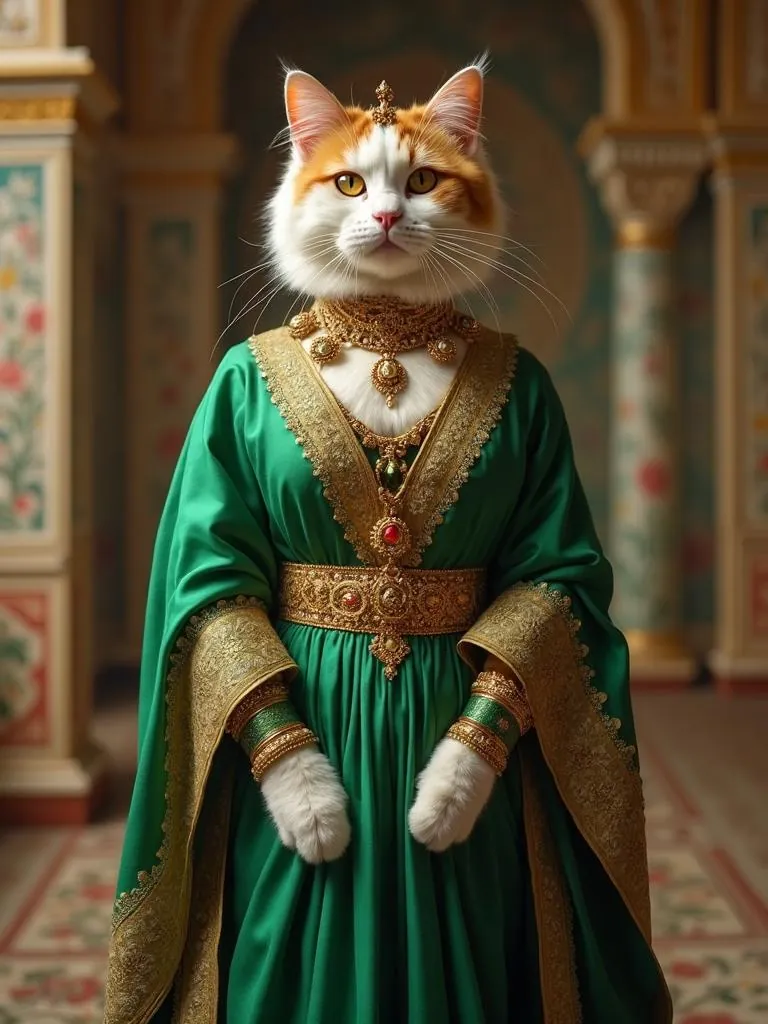
The gallery has portraits of cats in Mughal, Maharani and Renaissance styles. When your photo is ready, the portrait studio lets you choose from fifteen royal styles and upload a photo of up to five MB.
Questions and answers
Where did Scottish fold cats come from?
Scottish fold cats come from Scotland, where the breed began on a farm in Perthshire in 1961. The Cat Fanciers's Association says a white barn cat called Susie was the first known Scottish fold. Her ears folded forward and down over the front of her head. A local farmer called William Ross saw the cat on a neighbour's farm and asked for one of her kittens. The breed descends from that line.
Who was Susie?
Susie was the founding cat of the Scottish fold breed. The Cat Fanciers's Association says Susie was a white barn cat born in 1961 on a farm in the Perthshire region of Scotland. Her ears folded forward and down against the front of her head, a feature that is now the breed's defining trait. Susie had a litter of kittens in 1963, and one of them, a white female called Snooks, became the first Scottish fold used in a breeding programme.
Who was William Ross?
William Ross was the Scottish shepherd who began the Scottish fold breeding programme. The Cat Fanciers's Association says Ross and his wife Mary lived near the Perthshire farm where Susie lived and noticed the cat's unusual ears. When Susie had a litter in 1963, they asked for one of the kittens. They named the kitten Snooks and started a breeding programme with the help of a geneticist, Pat Turner, who kept records of the first generations of the breed.
When was the Scottish fold recognised as a breed?
The Cat Fanciers's Association accepted the Scottish fold for registration in 1973 and granted it championship status in 1978. The International Cat Association followed in 1979. The British Governing Council of the Cat Fancy had registered the breed in the late nineteen sixties but withdrew registration in 1971, after concerns were raised about the health of the breed's ears and joints. The Scottish fold is now recognised in North America but not in its country of origin.
Why do Scottish fold cats have folded ears?
Scottish fold cats have folded ears because of a dominant genetic mutation that affects cartilage development. The Cat Fanciers's Association says the fold gene produces an ear that curves forward and down at the tip instead of standing upright. The same gene affects cartilage elsewhere in the body, which is why responsible breeders cross a folded cat only with a straight-eared partner. Two copies of the fold gene in one kitten produce joint problems that can be severe and lifelong.
Are all Scottish fold kittens born with folded ears?
Scottish fold kittens are not born with folded ears. The Cat Fanciers's Association says all Scottish fold kittens have straight ears at birth, and the fold begins to appear between three and four weeks of age. Not every kitten in a litter from one folded and one straight-eared parent carries the fold gene. Kittens that retain straight ears are called Scottish Straights and are used in breeding programmes to produce more folded kittens in future generations.
What is the temperament of a Scottish fold?
The Cat Fanciers's Association describes the Scottish fold as gentle, affectionate and even-tempered. The breed is known for a soft voice and for sitting in unusual positions, including the so-called Buddha pose, with the cat upright and its back legs stretched out in front. Scottish folds tend to bond closely with one person in the household but accept other family members and other pets. The breed is quiet and adapts well to apartment life.
What colours do Scottish folds come in?
The Cat Fanciers's Association recognises the Scottish fold in a wide range of colours and patterns. Solid colours include white, blue, black, red and cream. Tabby patterns in silver, brown and red are all accepted, along with calico, tortoiseshell and bi-colour patterns. The colour-point pattern is also recognised in some registries. The breed comes in longhair and shorthair varieties, with the longhair version sometimes called the Highland Fold or the Scottish Fold Longhair.
Are Scottish fold cats recognised in Britain?
The Scottish fold is not currently recognised by the British Governing Council of the Cat Fancy, the main British registry. The Cat Fanciers's Association says the GCCF registered the breed in the late nineteen sixties but withdrew registration in 1971 over health concerns about the fold gene. The Scottish fold has continued to be recognised in North America, where the Cat Fanciers's Association and The International Cat Association both accept it, and most breeding of the Scottish fold today happens in the United States and Canada.
How do I photograph a Scottish fold for a royal portrait?
A Scottish fold's most striking feature is the folded ear, which pairs with a round face and wide-set eyes. Hold the camera at the cat's eye level and use soft window light from the side to bring out the shape of the folded ear and the roundness of the face. A plain background keeps the focus on the head. Wait for a still moment and tap the nearest eye to focus. The guide to [photographing cats](/guides/pet-photo-guide/photographing-cats) covers angles and timing.
Sources
- Scottish Fold, The Cat Fanciers's Association
- Scottish Fold Breed Article, The Cat Fanciers's Association
- Scottish Fold Breed Standard, The Cat Fanciers's Association
Share this guide
The button copies a ready-written post, then opens LinkedIn. Paste the text into the post box.
Go deeper
The full guides on this topic, each a set of pages with sources: